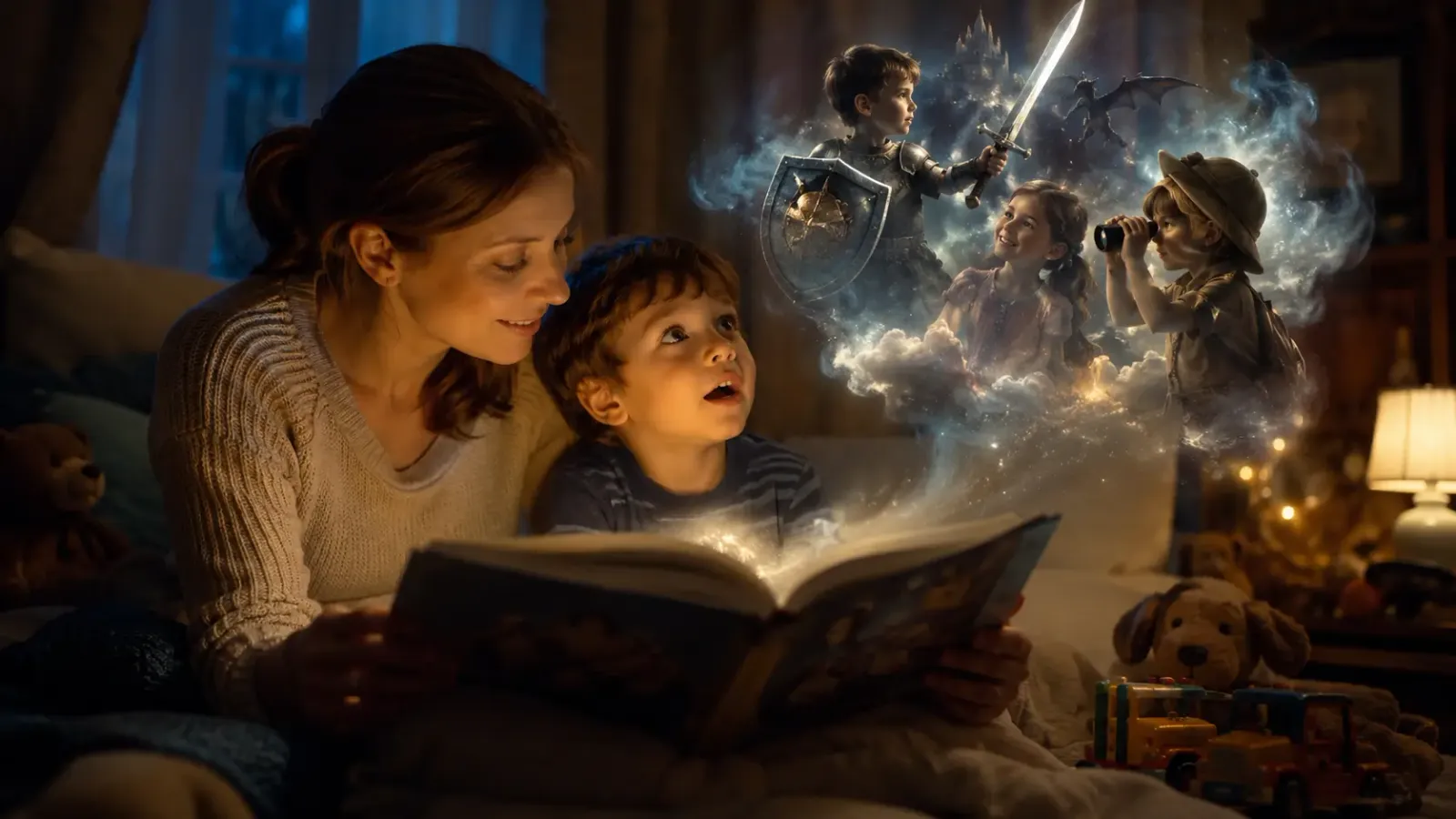
Why kids retain lessons from stories far better than from lectures
"Time to put those toys away."
"Treat others with kindness."
"Don't give up too quickly."
Every day, parents dish out advice by the dozen.
Still, there are times when kids seem to let that advice go in one ear and out the other.
But tell a good story about a brave knight, a helpful friend, or a curious explorer, and suddenly the message takes hold.
Why does this trick actually work?
The human brain is wired to love a good story
Storytelling has been with us for thousands of years.
Long before there were books, people passed knowledge down through storytelling.
That wasn't just a coincidence.
Our brains are hardwired to respond to stories.
They turn information into something clear and meaningful.
Stories carry emotion within them
Emotions are central to how we learn.
When a story stirs up tension, humor, or emotion, kids hold onto it longer.
A piece of advice delivered flatly tends to land with less emotional force.
Children learn by watching what others do
How someone acts tells the story.
Advice tells someone what to do.
That distinction matters.
Kids often get it faster when they can actually watch someone do it.
Stories spark the imagination
Reading a story, images take shape in the mind almost on their own.
Children picture the scene in their minds, in a sense.
This leads to deeper processing of the information.
Lower resistance
Advice can sometimes come across as orders.
Stories feel like discoveries.
This leads to a reduction in resistance.
Children often read their own meaning into a story.
Values come through in subtle ways
Stories teach children about:
- Friendship
- Perseverance
- Honesty
- Empathy
- Courage
Without these lessons ever being spelled out.
Why personalized stories hit even harder
When the child is the story's hero, the message hits even closer to home.
The child doesn't just watch how a hero behaves.
The child feels like that hero.
That often drives the lesson home harder.
What this teaches parents
Advice still matters.
Stories, though, have a way of making that advice stick.
Reading aloud is a simple, natural way to pass on the values that matter most.
Conclusion
Kids tend to hold onto stories longer than they hold onto advice, since a good story wraps emotion, example, and imagination all into one.
They turn abstract lessons into something concrete and easy to grasp.
That's why storytelling has endured for centuries as one of the most powerful ways to pass down knowledge, values, and experience.
And maybe that's exactly why a good story can land harder than a hundred well-meant pieces of advice ever could.