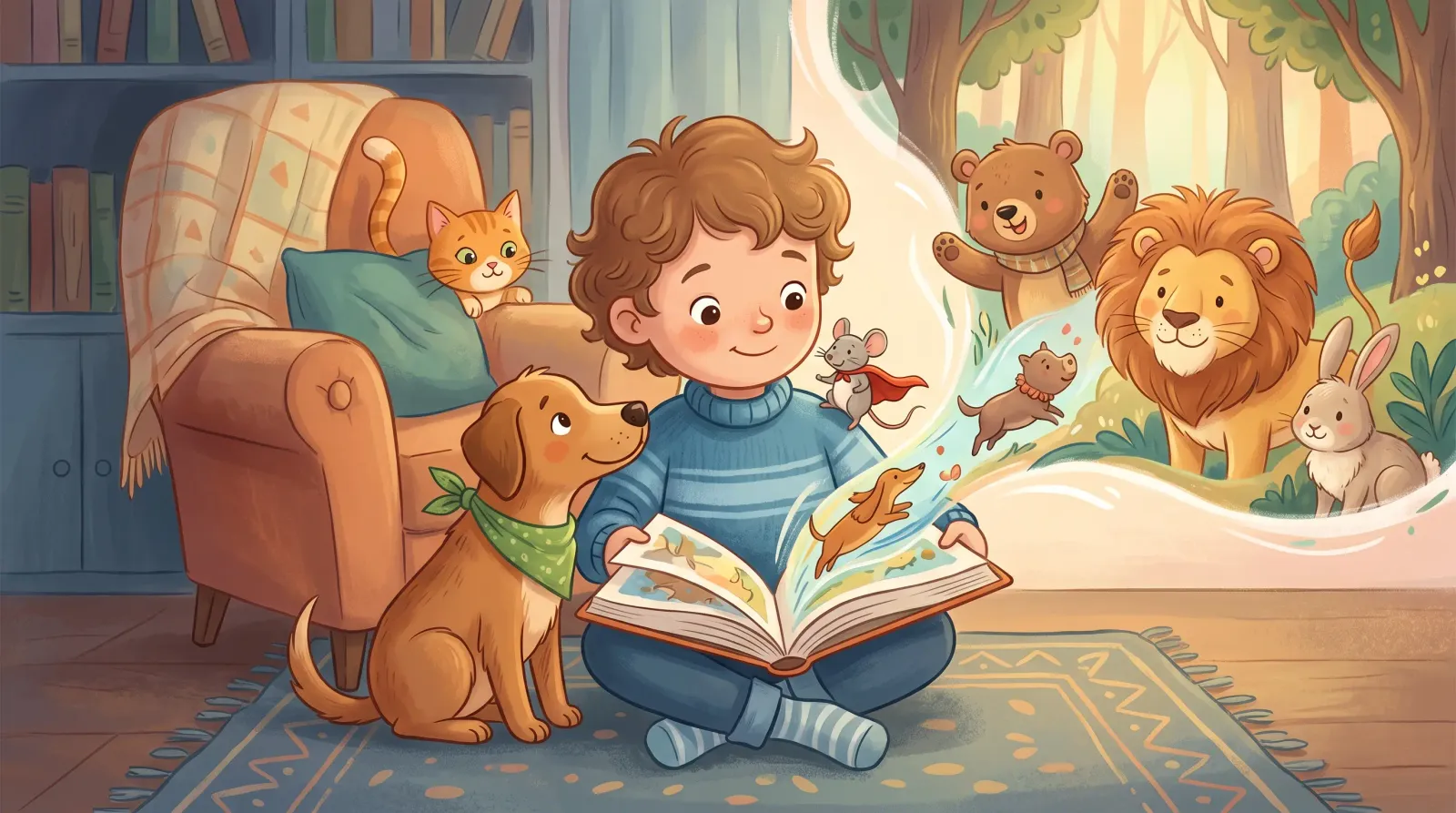
A dog who can actually talk.
A clever little mouse who manages to outwit a giant.
A bear off on an adventure.
A cat stumbling onto a secret.
Children's books are full of animals from cover to cover — and that's hardly a coincidence.
...tend to speak more plainly and act without hidden motives, so kids find them easier to relate to.
be recognizable, yet still leave enough room for all sorts of adventures to unfold
make
A dog might just start talking out of nowhere.
A rabbit can turn into a detective.
A lion can rule as king.
The story's greatest hero can turn out to be a tiny mouse.
Why do kids find animal stories so captivating in the first place? And is there something these tales can actually teach them along the way?
1. Recognizable animals
Even from a young age, children start interacting with animals.
A pet.
A farm animal.
A bird in the garden.
A dog out on a walk.
Or the animals at the zoo.
That's why children grow up knowing animals so well.
When such a character later steps into the spotlight of a story, viewers immediately know who it is.
A child, for instance, already knows what a dog looks like, how a cat tends to act, or roughly how big a
elephant is roughly.
That's the point where you, as the storyteller, get to layer in all kinds of imaginative touches.
Animals make stories easier to relate to
A tale featuring a talking fox is often far simpler to follow than some convoluted
story set in an entirely unfamiliar fantasy world.
The child has already met the fox before.
The writer can then take that familiar character and build an entirely new world around them.
That makes animals a sort of bridge linking the real world to the realm of fantasy.
A creature we all know finds itself thrown into an adventure like no other.
That combination is exactly what makes a story worth telling.
3. Kids can pick up on emotions, too
Children's books frequently give animals distinctly human traits.
The bear is sad.
The dog is jealous.
The mouse is frightened.
The lion is brave.
The cat is curious.
Through this, children learn to recognize emotions without the story having to be directly about them.
goes.
You can ask questions as you go along:
"What do you suppose is going through that dog's mind right now?"
Or:
"Why is the mouse scared?"
And another thing:
"Ever get that feeling yourself?"
That's how a plain old animal story can end up sparking a conversation about feelings out of nowhere.
4. Even the smallest creatures can turn out to be heroes
One of the best things about animal stories is that the tiniest creature can turn out to be the biggest hero.
can be.
A tiny mouse can untangle a problem far bigger than itself.
A young bird can learn to fly.
The rabbit can pull through even a dangerous situation.
That sends kids a message that matters:
You don't need size or strength to pull off something extraordinary.
Courage, intelligence, perseverance, and kindness can matter just as much—if not more.
5. Animals spark the imagination
Which sounds more far-fetched: an animal that talks, one that flies, or one that builds its own house?
For kids, that's nothing unusual.
It genuinely blew me away.
Fantasy stories, then, find fertile ground in animals as a natural starting point.
What was your favorite part of the book?
"If your dog could speak, what do you think he'd tell you?"
Or:
"If your cat had a covert assignment starting tomorrow, where do you think he'd head off to?"
A whole story will probably take shape in your mind within seconds.
Animals can show children what it means to care for another living thing.
A story about a pet is also a great way to bring up the idea of responsibility.
What does a dog actually need?
Why do cats need food and water in the first place?
Why can't you simply bring a wild animal home to live with you?
Why should animals always be treated gently?
Stories offer a natural way to bring up subjects like this.
Without ever feeling like homework.
7. Children learn to be mindful of others
In countless animal tales, the characters have to team up to get things done.
A group of animals has to work together to solve a problem.
An animal is in trouble and needs help.
Another character has some sharing to learn.
Or someone realizes that what they do actually affects another person.
That gives parents a good chance to ask questions.
"Why would the dog want to help the mouse, anyway?"
"What if everybody out there just looked out for number one?"
"What could you do about it?"
This lets you explore themes like friendship, cooperation, and consideration for others within the framework of a fantasy story.
get along with others.
8. A pet can end up being a kid's closest companion
For kids who have a pet of their own, seeing an animal show up in a story can feel especially meaningful.
It's more than just a character.
It feels like being around someone familiar.
Picture the dog that curls up on the couch beside your child day after day, all at once right there with him or
she sets off on an adventure.
The story then takes a deeply personal turn.
For instance, in a personalized children's book, that pet could even be written into the
adventure.
At Booklydoo, you can craft a story where your child takes center stage, with familiar
can also earn its spot in the story.
become part of the story. (booklydoo.com)
That's what makes a story hit closer to home.
Nine. Bringing animals into difficult subjects can make them easier to handle.
A child scared of the dark may open up more easily if the conversation is framed around a little rabbit
that walking through the forest alone scares her.
A child who struggles to make new friends can find something of themselves in an animal that
meeting a new group of people for the first time.
A child who flares up over the smallest thing might come to understand, through a lion learning to manage his temper, how to do the same.
anger
The farther away an animal is, the less immediate the shot feels.
You start by talking about the character.
About yourself, maybe.
Animals suit just about any kind of adventure
That, perhaps, is where animals truly have us beat.
They can crop up anywhere.
In a forest touched by magic.
On a farm.
In the vastness of space.
Underwater.
In a castle.
In a sprawling city.
At home—it's just as easy.
A dog can end up as an astronaut.
A cat could easily pass for a detective.
A horse can make its way through an enchanted forest.
A penguin might set off on a quest for buried treasure.
There's really no limit to it.
Why animal characters make personalized stories so effective
A personalized story is built around the moment of recognition.
The child recognizes a piece of themselves in the main character.
But you can throw in famous people and animals too.
That personal touch makes the adventure hit even closer to home.
Picture this:
Your child wakes up one morning to find that the dog has stumbled upon a secret message.
They team up to investigate.
They run into a talking owl.
He says a hidden treasure lies deep within the forest.
Only your child and his faithful dog stand a chance of finding the treasure.
For a kid, that's no small story.
The self reveals itself over the course of this adventure.
A story about a beloved animal
Even if you've never owned a pet, that doesn't stop you from finding animals fascinating.
Maybe your kid can't get enough of horses.
Or dinosaurs.
Or elephants.
Or sharks.
Or cats.
On or precisely on a tiny little insect.
Play to that interest.
A child who latches onto a particular animal often ends up more curious as a result
where you'll find a story featuring that animal.
Which animal would your child pick?
One playful way to kick off a story together:
"If you had to pick a single animal to be your best friend, which one would you go with?"
After that:
"So where would the two of you head off to together?"
"Does your animal talk?"
"Does it have any special powers?"
"What's the single biggest problem you need to solve right now?"
Before you realize it, a full-blown adventure has taken shape.
From Favorite Animal to a Storybook All Your Own
A child shouldn't be limited to reading stories about animals.
It can even become a part of that story itself.
At Booklydoo you can create a personalized children's book that puts your own child at the center of the story
goes off on an adventure with an animal.
You can add a photo and your child's name and drop in all sorts of characters. That way
there emerges a story that speaks to the child's interests and lived experience.
A dog, loyal to the end.
A cat as an enigmatic ally.
A horse to ride alongside you on your adventures.
Or perhaps a wholly imaginary creature, one you won't find anywhere else in the world.
You can preview the digital version before deciding whether it's worth ordering in hardcover.
Stories children remember long after the last page
You might even recall a children's book you had growing up, one where an animal played the lead role.
A certain bear.
A dog with a mischievous streak.
A cunning rabbit.
A fearless little mouse.
That isn't all that surprising.
Animals may seem simple to spot, but they still offer endless creative possibilities.
They can be pretty hilarious.
Dapper.
Bang.
Naughty.
Smart.
Shy.
Or maybe all of them at once.
Which is exactly why kids take to them so naturally.
An animal isn't always just a character
An animal in a children's book can feel like a friend.
An example.
A helper.
A touch of comedy.
Or the story's hero.
But more than anything, it beckons you to daydream.
Because the moment a child starts wondering:
"What would my dog say if he could actually speak?"
that's actually where the story begins.
Maybe that's exactly why animals make such wonderful protagonists in children's books, generation after generation—they blur the line between reality and fantasy in the most delightful way.