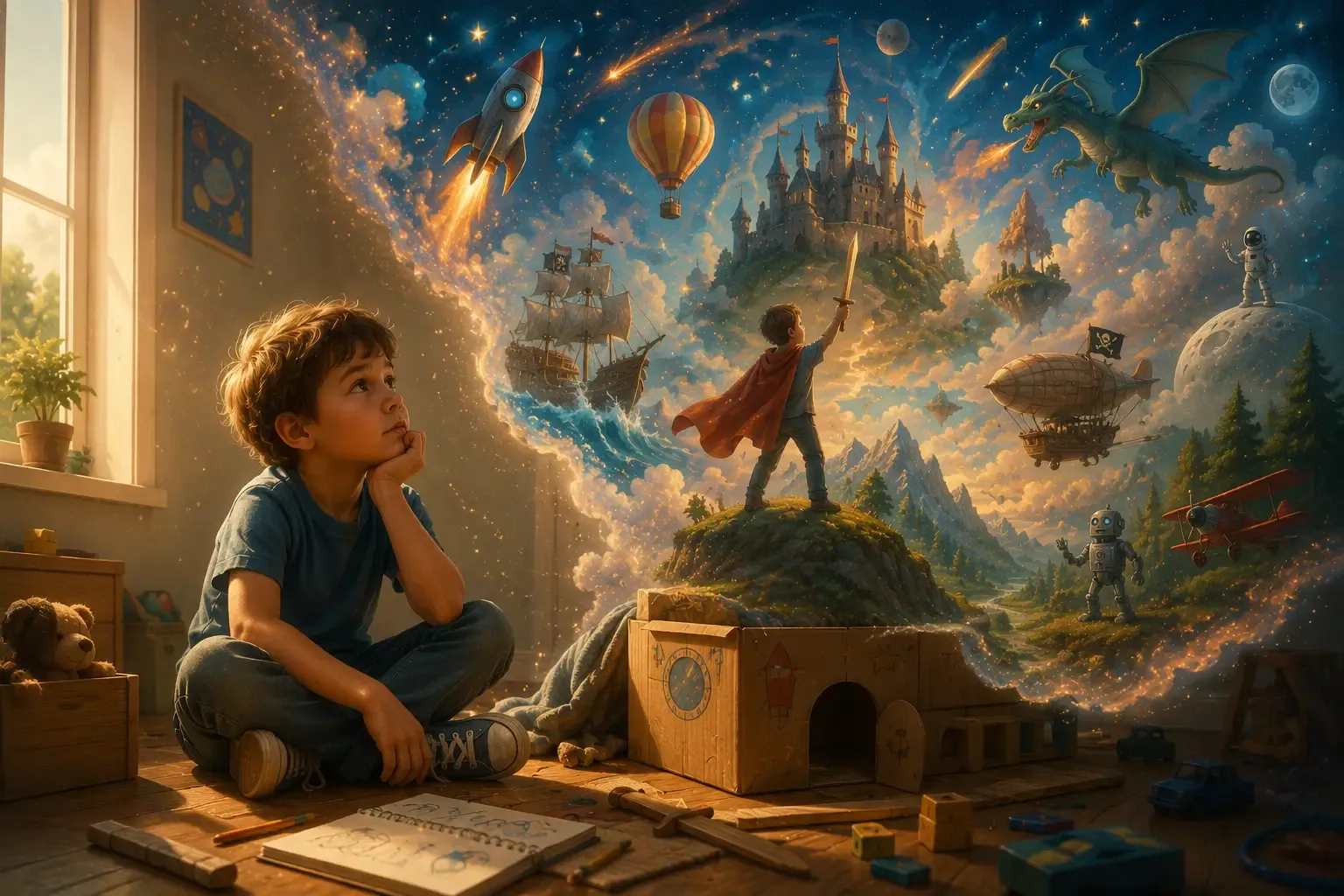
The day kids forgot how to be bored
There was a time when being bored simply came with the territory.
Kids sat in the car with nothing to look at but the window.
Sitting in restaurants that have no screens in sight, just waiting.
Spent time outdoors without feeling the need to fill every idle moment.
And perhaps that sounds odd, but there was real value in that boredom.
Boredom, after all, works a kind of quiet magic:
It sparks the imagination and pushes it into motion.
Why kids nowadays have a harder time letting their imaginations run wild
Kids these days are growing up with entertainment just a tap away, all the time.
Within seconds, they're able to:
- watch a video
- play a game
- listening to music,
- or endless scrolling.
This leaves less space for something that once happened as a matter of course:
making up stories yourself.
Still, imagination turns out to matter now more than ever.
Not just for creativity, but also for:
- problem-solving mindset
- emotional growth
- confidence
- and concentration.
Fantasy often springs from nothing at all.
Plenty of adults assume kids need something happening to entertain them at every moment.
But children often need surprisingly little.
An empty box might simply be:
- a boat,
- a time machine,
- a hidden underground bunker
- or a shop.
A walking stick turns into:
- a sword,
- a magic wand
- or a flag.
The capacity to glimpse "more" than what's literally in front of you is precisely what creativity is built on.
Why Stories Wield Such Power
Imagination needs a story to give it shape.
A good story cracks open a door in a child's mind.
Suddenly a flood of questions comes to mind, like:
- What would I do in that case?
- What lies beyond that door?
- Would I actually go through with it?
- How does this play out?
Children's books have mattered for generations precisely because of this.
Not because kids just do as they're told…
but because their mind is actively engaged.
Why kids love spotting themselves
And here's where things really pick up.
Picture a child suddenly catching sight of themselves in the story—what happens then?
Reading itself becomes a different experience entirely.
The story feels:
- more personal
- however,
- and more exciting.
A child stops thinking:
"That happens to other people."
But:
"Same here."
That's precisely why personalized stories carry so much weight.
Fantasy as a counterbalance to velocity
The world of children never stands still.
Screens flicker endlessly, image after image.
Apps demand ongoing upkeep.
The clips run just a few seconds long.
A story, though, operates on its own terms.
A story loses its momentum.
It asks:
- listen,
- propose,
- feel
- and think.
That's what makes stories feel almost like a refuge in a hectic world.
Why reading aloud is a small kind of magic
Reading aloud is something many parents fold into their bedtime routine.
But there's actually a lot more going on beneath the surface.
While reading aloud:
- a bond takes shape,
- slows the day down,
- and leaves room for imagination to breathe.
A child can tell when they're being paid attention to.
Rest.
Safety
Those are things a screen just can't replace, no matter how good the technology gets.
Perhaps kids could actually use a bit more boredom in their lives
That may sound like a contradiction.
But maybe the most beautiful ideas surface exactly when nothing has to happen at all.
When kids:
- looking at the clouds,
- sitting inside a hut,
- daydreaming over a story
That's usually when the imagination starts working on its own.
Why Personal Stories Stick With Us Longer
Most stories eventually get forgotten.
But it's the personal stories that tend to stay with us.
Because they end up tied to:
- age
- a passing phase,
- a feeling
- or a memory.
A child who spots a piece of themselves in a story carries it with them in a way other tales never quite manage.
Not the way "that book" does it.
But if:
"the adventure in which I myself played the hero."
Maybe imagination matters more than we give it credit for.
Grown-ups often have their own label for imagination: "pretend play."
But almost everything humans have ever created began life as a daydream:
- inventions
- art,
- stories
- music
- dreams
- ideas.
Maybe kids are just naturally better at it than we are.
Maybe it's time we started treating it with a bit more care.