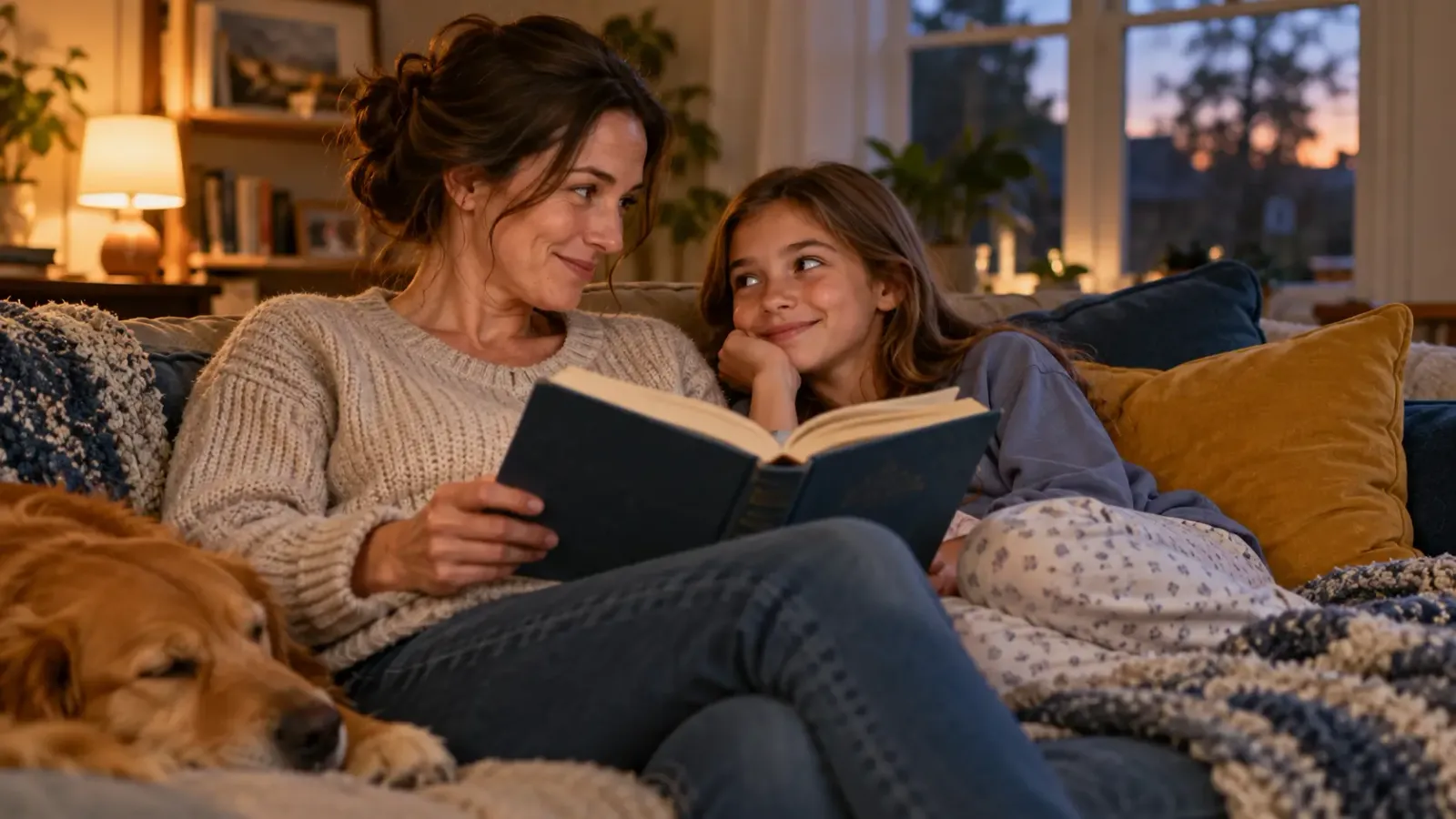
When kids are little, reading aloud comes so naturally that most families don't even think twice about it—snuggling up together on the couch, a story to wind down before bed, or that one favorite tale requested for the hundredth time.
But then your child learns to read on their own.
And bit by bit, the ritual of reading aloud is fading away—after all, why bother reading to a child who's perfectly capable of picking up a book alone?
Learning to read, though, doesn't mean story time has to stop. Plenty of kids—seven, eight, nine, ten years old, even older—still love nothing more than being read to.
Here's the thing: as kids get older, reading together doesn't fade away—it can actually turn into something truly special.
Reading on your own and actually enjoying it are two very different things
When a child can decode words on the page, that doesn't mean reading actually feels easy or enjoyable to them.
Reading on your own takes a surprising amount of concentration. You've got to recognize the letters, make sense of the words, keep track of the sentences—all while still trying to hold onto the thread of the story.
For adults, this happens almost without thinking. For kids who are still in the thick of learning, it takes real effort.
During reading aloud, none of that matters anymore.
Your child just has to sit back, listen, and imagine what happens next.
This way, during read-aloud time, a child sometimes gets to enjoy stories they'd never pick up on their own.
Reading aloud can simply be fun
Not every reading moment has to come with a lesson attached.
Reading a story together can make it all the more fun.
You curl up together on the couch, snuggle under the blankets before bedtime, or get through a chapter together each evening during the holidays.
For older kids, that sense of déjà vu can actually feel kind of nice.
During the day they grow more and more independent — school, sports, friends, hobbies, and often enough a screen all pull at their attention.
A read-aloud moment, then, is a different experience altogether.
No rushing. No pop-up alerts. No one barking orders.
Just a shared story.
You can pick stories that push you a bit harder
A big part of what makes reading aloud so valuable is that it frees you from having to stick to whatever level your child can technically read at.
Your child might be able to handle short stories on their own, but when it comes to what actually grabs their interest, they're probably craving something far more thrilling or intricate.
By reading aloud together, you can still explore those worlds side by side.
Stumble on a tricky word? Just take a moment to explain it on the spot.
If things get complicated? That's when you talk it through together.
This way, vocabulary and story comprehension build up naturally, without reading ever feeling like a chore.
Stories just naturally get people talking
A good story leaves you with questions.
Why would anyone do that?
Would you be brave enough to do the same?
Who do you think did it?
What's behind that door?
And how would you react if it happened to you?
With older kids especially, these kinds of conversations can turn out to be a real blast.
You get a window into how your child actually processes situations, and conversations sometimes wander into territory you'd never stumble on in the usual day-to-day chatter.
A book, in that sense, can be so much more than just a story — it becomes a chance to sit together, share a laugh, and let your imaginations run wild.
Sometimes, just let your child sit back and listen while someone else reads aloud.
Reading aloud doesn't have to be one-sided, either.
Flip the script.
Have your child read a passage out loud to you, then pick up where they left off. Or try assigning characters and acting out the dialogue together like a little play.
You could also alternate pages when reading aloud, each taking a turn.
For kids who still tire easily reading long passages on their own, this offers a nice compromise.
And in the meantime, they get practice in without it ever feeling like homework.
A story that genuinely suits your child is what you should be looking for
As children grow older, their personal interests tend to come into sharper focus.
One's crazy about football. The other's into horses, animals, mysteries, magic, science, or silly stories.
You can turn that to your advantage.
A child who claims they "don't like books" often just hasn't stumbled onto the right one yet.
Let your child have a say in the matter.
Don't just ask:
"Want to read together tonight?"
But, say, for instance:
"Funny or exciting—which one do you want to hear?"
That small gap alone can tip the scales significantly.
What if your child were actually a character in the story?
There's another way to pull a story in even closer: put your child right in the middle of the adventure.
In a personalized children's book, the main character isn't some made-up figure — it's your own child.
The character's name, looks, and other personal traits can all find their way into the story.
That's what makes it special.
Even a bigger kid who starts off insisting that being read to is "for babies" will perk right up the second their own name pops into the story.
What's in store for me?
What's my role here?
How does my adventure end up, exactly?
That curiosity is what makes a personal story worth reading on your own—and just as rewarding to explore together.
Turn it into a ritual that's all yours
Reading aloud to older kids doesn't need to happen every night.
Maybe weekends are the only time you actually get around to reading.
Or on vacation.
Maybe there's one hefty book you work through together, reading a chapter aloud each evening.
You could even turn it into a small ritual. Pour yourself something to drink, silence your phone, settle into the couch, and spend ten or fifteen minutes reading together.
It won't take much time at all.
Because it's a set moment the two of you share, a child has something to look forward to.
There's no fixed age at which you should stop reading aloud to your child — it really depends on the individual.
There's no set age at which it's supposed to happen.
Not once your child hits six.
Not once it learns to read on its own.
And it doesn't happen automatically just because it moves up to a higher group, either.
There's no real reason to stop, as long as you're both enjoying yourselves.
Maybe the way you read will never be quite the same again.
From picture books to chapter books. From nightly ritual to once a week. From reading every word aloud to trading off chapters.
Let it grow right alongside your child.
The most beautiful part of reading aloud might not even be the reading
Years from now, your child won't remember the exact number of books you read together.
But maybe it still holds onto that one thrilling story.
That same character kept cracking you up.
That you deliberately cut it off right at the most exciting part.
In the evenings you'd curl up under the covers and swear you'd read just one chapter together — which, of course, always turned into three.
Those small moments are the ones that end up becoming big memories later on.
Honestly, it makes no difference whether your child is 4, 8, or 11 — none at all.
Your child takes center stage in a story made just for them.
Want to make story time even more special?
With Booklydoo, you can put together a personalized children's book that makes your own child part of the story. That way, when it's time for storytelling, there's always at least one character your little one will instantly recognize—themselves.itself.
Explore Booklydoo's personalized children's books and pick out your family's next adventure.