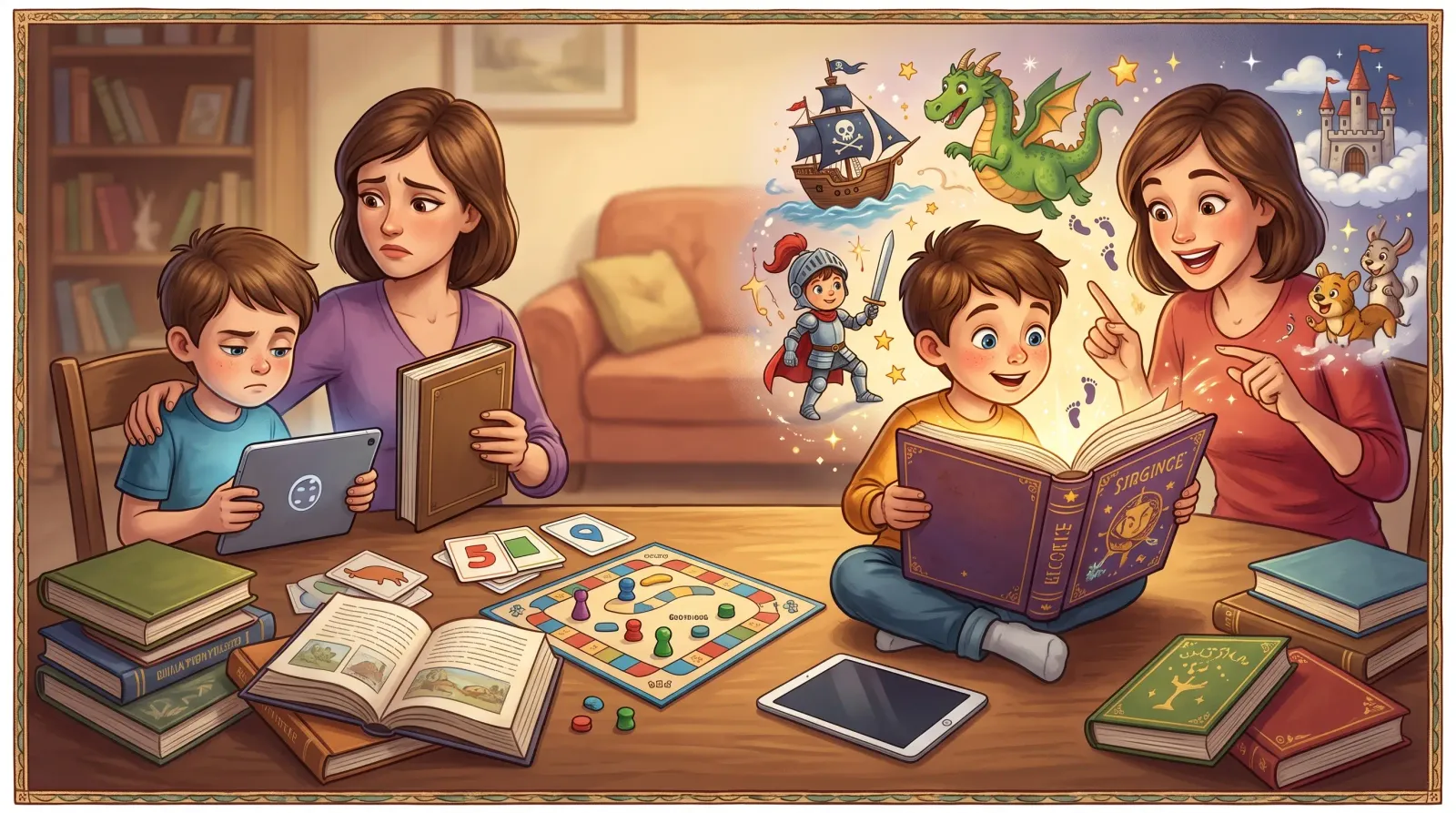
"Books are boring."
As a parent, that's probably not what you wanted to hear when you set a new children's book down in front of your kid. You'd picked out something lovely, maybe even carved out a special little reading moment for it, but your child couldn't care less.
The book closes. Attention drifts. And within minutes, someone's already asking for the tablet.
Sound familiar?
The good news is that doesn't necessarily mean your child dislikes stories — chances are, they just haven't found the right one yetwhich stories suit him or her.
With these 8 tips, you can bring back the fun of reading and make books feel exciting again.
1. Find out what genuinely lights your child up
A child who shrugs off one particular book isn't necessarily a child who dislikes reading.
The story just might not be grabbing your child's interest.
What subjects light up your child's imagination when they're not reading?
Does your child enjoy:
animals?
football?
cars?
princesses?
dinosaurs?
space travel?
magic?
adventure?
funny stories?
gripping mysteries?
Let those interests be your starting point.
A kid who could talk your ear off for hours about dinosaurs is going to reach for a book with a dinosaur on the cover way sooner than one about something they've never even heard of.
2. Let your child make their own choices
Ask most adults, and they'll tell you exactly what makes a children's book "good."
But that doesn't guarantee your child will love it just as much.
Let your child make their own choices on a regular basis.
Even if you don't think the book is the most educational choice out there.
A funny book can do just as much for a child's love of reading as an educational one. What matters most is that your child genuinely enjoys the stories.
When kids realize they actually have a say in what they read, their resistance to books tends to fade.
3. Turn reading into a two-way activity
A book doesn't have to mean one person reads aloud while the other just sits there listening.
Turn it into a two-way conversation.
Ask yourself, for instance:
"What do you reckon happens now?"
Or:
"Would you mind opening that door?"
It looks like you've only entered "En:" — that's just a label, not the actual Dutch text. Could you paste the Dutch passage you'd like translated? Once I have it, I'll get you an English version right away.
"Who would you bring with you on this adventure?"
You can also make sounds together, act out characters, or put on different voices for certain passages.
With young children especially, that can make all the difference.
A story turns into something you live through together, instead of just words sitting on a page.
4. Quit while you're ahead—before it stops being fun
Sometimes parents just want to bring a reading moment to a close.
But if your child's attention starts to drift after ten minutes, there's no need to shelve the whole book.
It can actually help to quit while you're ahead.
End on a compelling moment—something that leaves the reader wanting more.
And that's when Lisa heard it — a sound right behind her.
Stop.
Tomorrow continues.
Your child's curiosity to find out what happens next may have them begging you for another chapter tomorrow night.
5. Use humor
Kids can't get enough of a good funny story.
A wacky character, an unexpected twist, or an amusing picture can grab a child's attention far more than a straightforward explanation ever could.
Humor also keeps things from feeling too heavy while you read.
It doesn't have to be some deep, meaningful lesson every time.
A book is sometimes there for nothing more than sharing a laugh together.
That, too, is part of the pleasure of reading.
6. Connect reading to real life
The story doesn't have to be over just because the book ends.
If you've just read a story about animals, take a few minutes afterward to look up more information about them together.
Read a story set in a forest? Head out to an actual forest afterward.
Does the story unfold in space? Then step outside together some evening and take in the stars.
That way, the book stays tethered to the real world.
A story stops being something you merely read and turns into something you actually experience.
Give your child a story where they can see themselves
For some kids, a story simply hits different when it feels like it's about them.
Picture this: the main character shares a name with your kid.
That your child bears a striking resemblance to the main character.
And imagine the adventure unfolding in a world where, say, their own pet, sibling, or best friend shows up too.
Suddenly, a stranger turns into someone who feels close to your heart.
That's the whole point behind personalized children's books.
With Booklydoo, you can turn your child into the star of their very own book. Just upload a photo, add their name, and watch a personalized story come to life with illustrations to match. Want to include siblings or friends? You can even feature several characters in the same adventure.booklydoo.com)
For a kid who sometimes feels a little disconnected from ordinary stories, this can be a fun way to fall back in love with reading.
8. Don't make reading feel like homework
Maybe the single most important tip of all:
Reading shouldn't feel like a fight.
When a child keeps hearing that reading is something they "have to" do, a book can start to feel less like a pleasure and more like a chore.
Instead, just focus on having fun.
Sharing a laugh together.
Dream together.
Discover it together.
Share a story together.
Maybe today your child only manages five minutes of reading.
That's fine.
Tomorrow it might only be ten minutes.
And next week, your child might be the one asking for a new book.
That's the destination you're ultimately aiming for.
What if, despite everything, your kid just can't get into any book?
Maybe it's time to rethink where you're starting from.
What would you say instead?
"Which book should my kid read next?"
you'd better ask:
"What kind of story would blow my kid's mind?"
That difference may look minor on paper, but it can end up mattering a great deal.
A child who tugs at every story you tell might light right up once they realize they're the one having the adventure.
A child who's crazy about animals might love hearing a story where their own dog gets to be the hero.
A child who's into fantasy might not care about reading about some unfamiliar character at all — what they really want is to be the astronaut, pirate, princess, or superhero themselves.
Curiosity is where reading begins
Not every book a child reads has to blow them away.
What matters most is that they discover stories have the power to move you.
They can make you laugh out loud.
To scare you.
Learning something.
Whisk you away to another world.
Or even hand it the starring role.
That's why, instead of just pulling the next random book off the shelf, it can help to seek out a story that genuinely speaks to what your child is experiencing.
A book made just for your child
At Booklydoo, you can put together a personalized children's book that stars your own child as the main character.
Just pick a story and theme, upload a photo, add a name, and the AI takes it from there—generating a personalized story complete with illustrations. Before committing to a printed hardcover copy, you get to preview the digital version and make any edits you like.
So a book suddenly turns into something more than just a book.
It isyour story.
And perhaps that's exactly the spark needed to make a book-averse child curious again.
Because once you spot yourself inside a story, reading stops feeling like reading at all — it starts feeling like an adventure.