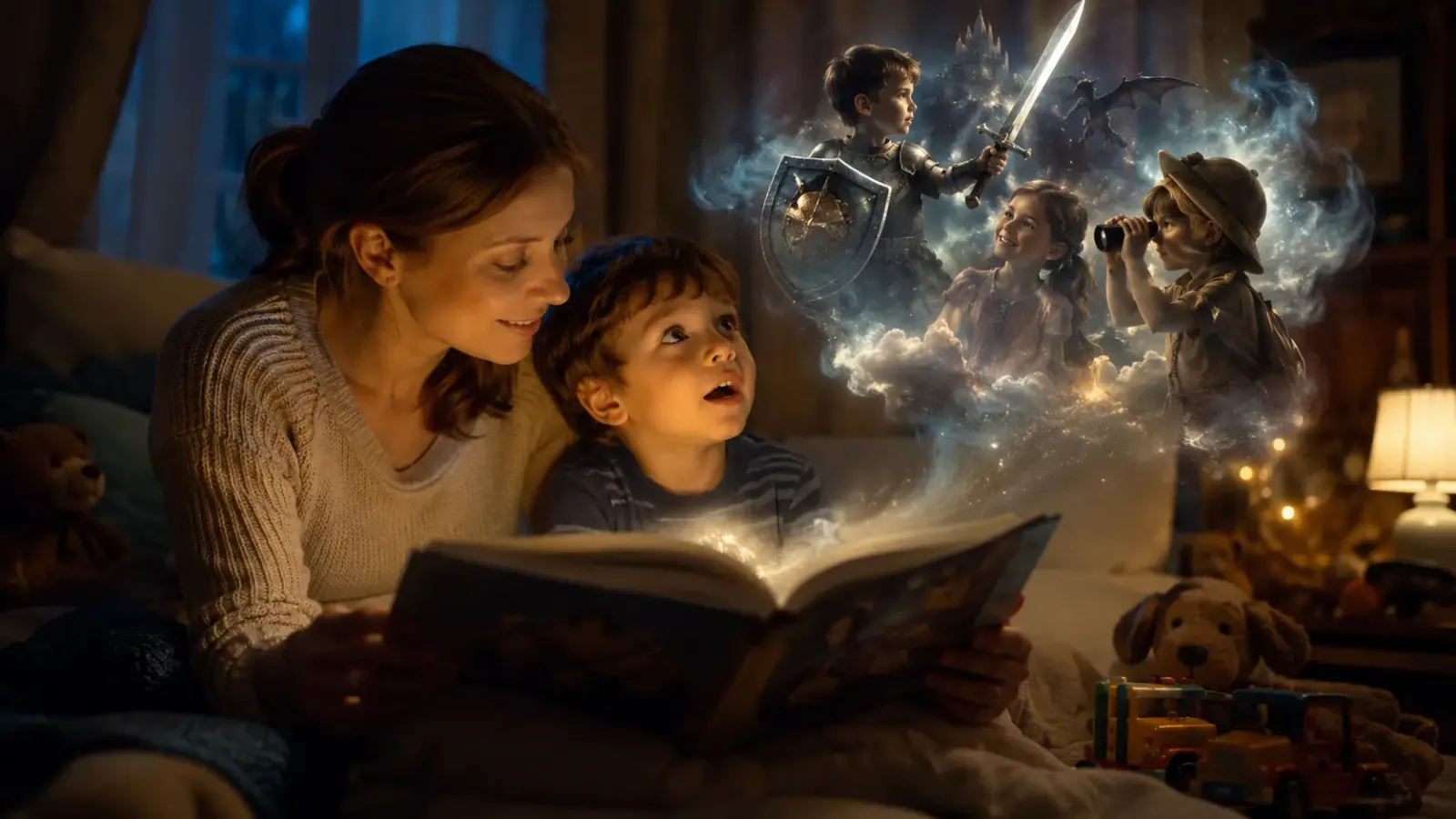
Kids hold onto stories far more easily than they do lectures.
"Put away your toys."
"Be kind to others."
"Don't throw in the towel too soon."
Every day, parents dish out advice by the dozen.
It's almost as if kids let that advice go in one ear and out the other.
And suddenly the message sticks—tell a good story about a brave knight, a helpful friend, or a curious explorer, and kids remember it.
Why does this actually work?
The human brain is wired for storytelling
Storytelling stretches back thousands of years.
People passed down knowledge through storytelling long before the written word ever existed.
That was no accident.
Our brains are simply wired for stories.
They turn raw information into something readers can actually grasp and use.
Stories carry emotional weight
Emotion is a driving force behind how we learn.
When a story stirs up tension, laughter, or genuine feeling, kids simply hold onto it longer.
Advice served up dry-eyed tends to land with less emotional punch.
Kids pick up habits by watching the people around them
This is the kind of detail that reveals character through action.
A piece of advice suggests what someone ought to do.
That distinction matters.
Kids tend to grasp a behavior more easily once they've watched it in action.
Stories spark the imagination
As a story unfolds, pictures start taking shape in the mind.
Kids can more or less picture the scene in their minds.
That way you actually process the information at a deeper level.
Fewer obstacles
Advice can sometimes come across as orders.
Stories feel like discoveries.
This means there's less resistance.
Children often come to their own conclusions after hearing a story.
Values come through in subtle ways
Stories teach kids about:
- Friendship
- Perseverance
- Honesty
- Empathy
- Courage
Without these lessons ever being spelled out.
Why personalized stories pack an even bigger punch
When the child is the story's protagonist, the message hits even closer to home.
The child sees more than just how a hero acts.
The child sees itself in that hero.
That often drives the lesson home even harder.
What this teaches parents
Advice still matters.
But a good story can make those recommendations stick.
Reading aloud is a simple, natural way to pass down the values that matter most.
Conclusion
Kids tend to hold onto stories longer than they do plain advice, since a good story weaves together feeling, example, and a spark of imagination.
Abstract lessons become concrete and easy to grasp this way.
That's precisely why storytelling has endured for centuries as one of the most powerful ways to pass down knowledge, values, and experience.
A good story, in fact, can sometimes hit harder than a hundred well-meaning pieces of advice ever could—and maybe that's the whole point.