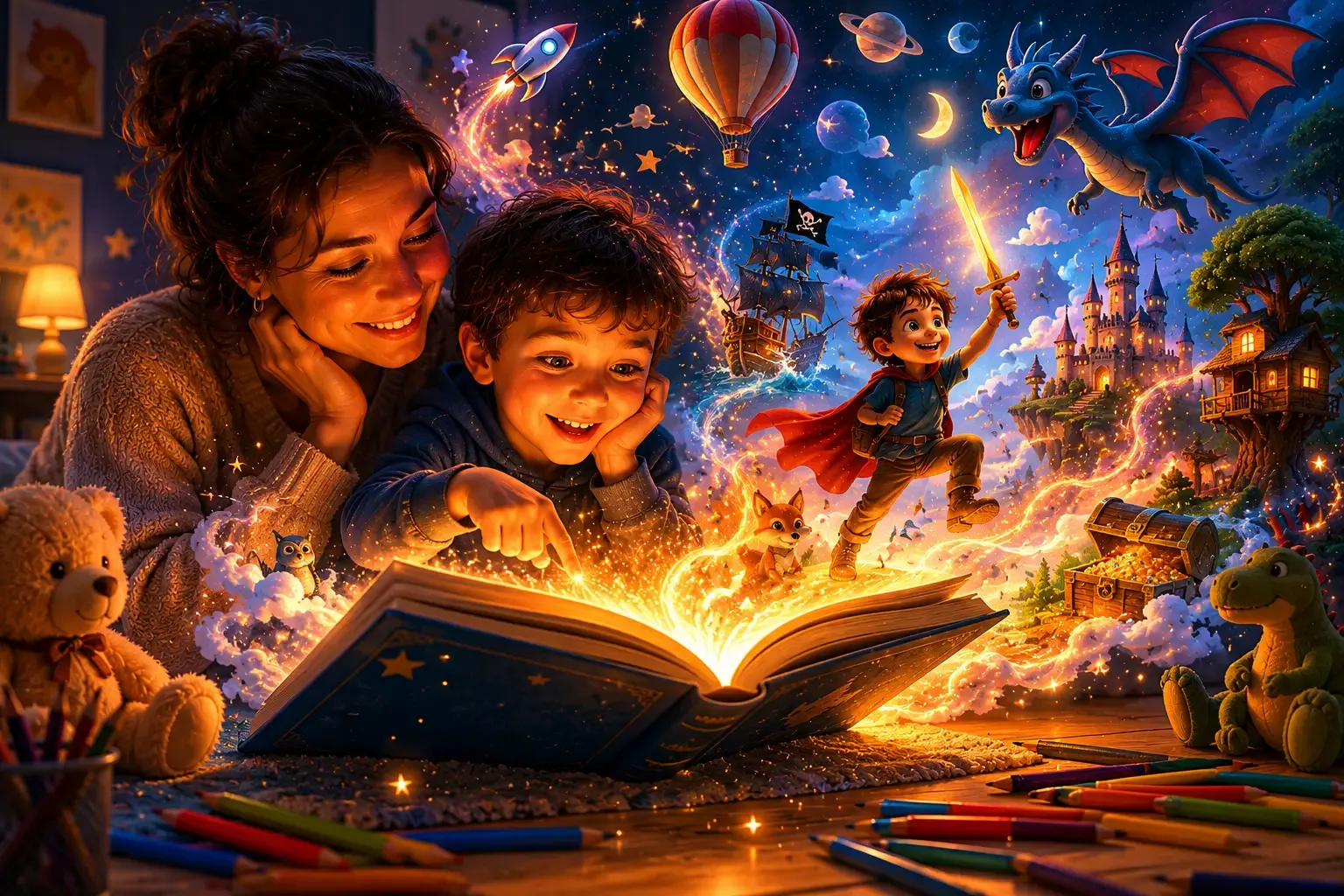
The psychology of personalized children's books: what makes kids light up when they spot themselves in a story
Why does a child's whole face light up when they spot themselves in a book? Why do they suddenly perk up and listen closer the moment they hear their own name? And why do they beg to hear that same story, tailored just for them, over and over again?
The answer comes down to psychology.
Platforms like BooklyDoo tap cleverly into something deeply human: the desire for recognition. When kids spot themselves in a story, they connect with it on a whole different level. That's what makes personalized children's books more than just a fun idea—there's real psychology behind why they work so well.
Children are naturally wired to see the world through their own eyes
That may sound like a knock against kids, but in developmental psychology it just refers to the fact that young children see the world entirely through their own eyes.
For young children, so much comes down to:
- "I"
- "mine",
- "What's going on with me?"
That's the whole reason personalization is so effective. Once a child spots themselves in a story, it just naturally feels more meaningful — more like it belongs to them.
Recognition draws attention
Personal information hits us harder than facts and figures ever could.
Consider, for instance:
- hearing someone say your name across a noisy room,
- recognize your face in a photograph
- or come across something that feels like it was written just for you.
When kids are the audience, this effect kicks in even harder. That's why a story built around them holds attention far quicker than any off-the-shelf book.
Confidence and a sense of who you are
Children build their sense of identity out of the stories they hear and the experiences they live through. Picture a child seeing themselves as:
- I see you've entered "held," the Dutch word for "hero" — though it looks like just a standalone piece without much surrounding context. If you simply want that one word translated, it's: hero But if it's part of a longer sentence or phrase, feel free to share more so I can give you a more precise translation.
- explorer,
- clever problem solver
- or intrepid adventurer,
can help build self-confidence.
Stories help children think about:
- who they are,
- what they can
- and how they handle challenges as they arise.
Why kids grasp feelings more easily when they come wrapped in a story
Children's books offer a safe space for kids to make sense of their emotions.
In a personalized story, the child is the one living it.
- exciting situations,
- friendships
- challenges
- fears.
That helps children get a better handle on their feelings and put words to them.
Young children especially tend to grasp emotions more readily through stories than through straightforward explanations.
Personalized stories nonetheless feel
Ordinary stories are made up. But when a child:
- sees his own name,
- recognizes what he looks like,
- recognizes familiar elements it already knows,
the line separating fantasy from reality starts to blur a bit.
That immersive quality is what really draws players in.
Why repetition puts children at ease
Why do kids beg for the same bedtime story night after night? It's a question that leaves plenty of parents scratching their heads.
From a psychological standpoint, repeated exposure offers:
- predictability
- control
- and safety.
That effect tends to be even more pronounced with personalized stories, simply because the story hits closer to home.
Imagination doesn't just fuel daydreams—it shapes how we solve problems, empathize with others, and envision futures that don't yet exist.
Fantasy plays a vital role in how children grow and develop.
Through imagination, children learn:
- solving problems
- creative thinking,
- developing empathy
- and run through different scenarios.
With BooklyDoo, personalization takes imagination to a whole new level. Kids aren't just reading a story—they become part of it.
Because they're not just buying a product—they're seeing their child reflected in a story for the first time, and that hits differently than any generic gift ever could.
Personalized books don't just delight kids—parents get just as emotional seeing their child cast as the story's hero.
That's the reason:
- it feels personal
- creates lasting memories,
- and freezes a particular era in place.
Plenty of parents hang on to books like these for years, treasuring them as keepsakes.
Technology has made personalization accessible to everyone
With AI in the mix, personalized books used to come with a hefty price tag and slim pickings — but platforms like BooklyDoo have changed that. Now they can:
- generate one-of-a-kind illustrations,
- adapt the stories
- and churn out books quickly.
This puts personalized reading within reach for a much wider range of families.
Conclusion
The rise of personalized children's books isn't just a passing trend—it taps directly into the way kids naturally think, learn, and work through their feelings.
Platforms like BooklyDoo blend recognition, imagination, and personal involvement to craft stories kids don't merely read—they live them.