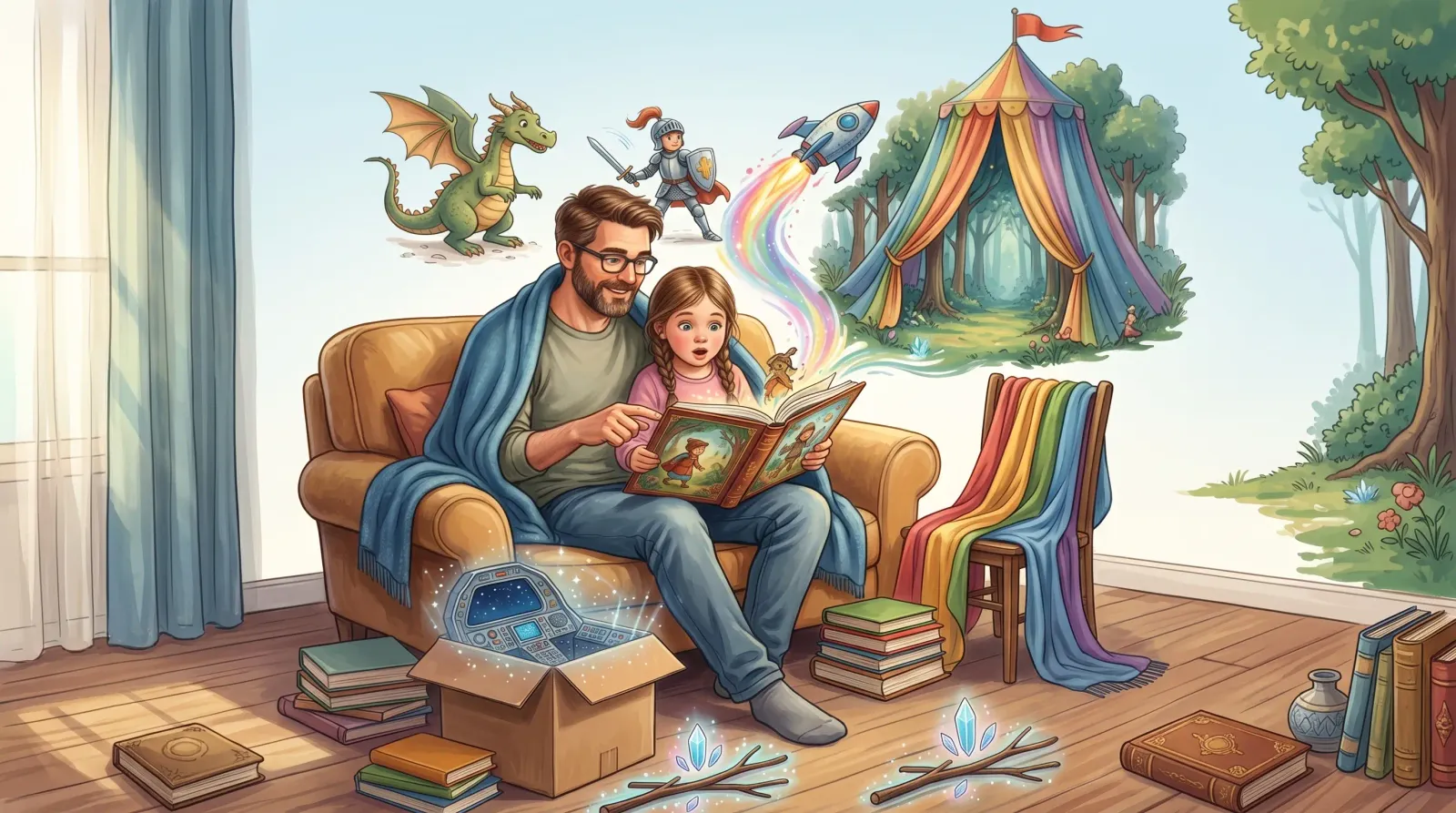
A cardboard box turns into a spaceship, a blanket becomes a tent, a stuffed animal is suddenly given a voice of its own—and just like that, an ordinary walk through the park becomes a thrilling expedition.
Children's imaginations run wild, seemingly without limit.
Still, it's not always obvious how to actually spark that imagination. Do you need special toys for it? Does it mean planning creative activities day after day?
Thankfully, no.
It doesn't take much to fire up a child's imagination—often the simplest things do the trick. Stories, questions, play, and a little space to figure things out on their own: these are what let kids build a world of their own.
Here are 10 easy ways to spark your child's imagination.
Read imaginative stories together
Nothing sparks a child's imagination quite like a good story.
While reading, so much more is going on than just tracking words across a page. A child pictures what a character might look like, imagines where the story unfolds, and starts guessing what comes next.
A castle takes shape in the mind's eye. A forest develops a mood all its own. A dragon comes into focus, gaining a face.
Every so often as you read aloud, pause to toss out a question:
"What do you reckon the castle looks like?"
"What would you do if you were in that position?"
"What color would the dragon be?"
"So where do you reckon the treasure's hidden?"
This way, your child isn't just listening to the story — they're becoming part of it.
2. Let kids invent stories of their own
You won't always be the one doing the talking.
Let your child take the lead and tell the story.
Start with something like:
"Once upon a time, there was a little girl who woke up one morning to find that her stuffed animal had started talking…"
And let your child pick up the story from there.
It doesn't matter whether the plot holds together. A talking cat, a bicycle that flies, a princess who lives in a submarine—anything works.
The freedom itself is what feeds the imagination.
3. Ask open-ended questions
A question with only one right answer doesn't leave much space for imagination.
Make it a habit to ask open-ended questions on a regular basis.
Instead of:
"Is it a big dog?"
can you ask:
"So how big do you figure this dog actually is?"
Or:
"If you woke up today and suddenly found you could fly, what would you do?"
There's no right or wrong answer here—the point is to get your child thinking on their own.
4. Give everyday objects an unexpected twist
Kids can dream up the most imaginative games without any fancy toys at all.
A box can turn into a house.
A pillow can turn into an island.
A chair can just as easily become a spaceship.
A stick can turn into a magic wand.
Try not to jump in and correct your child right away just because they're using an object differently than it was designed for.
If your child says a cardboard box is a pirate ship, then it's a pirate ship.
5. Let your child sit with boredom sometimes
Boredom doesn't always get the credit it deserves.
When a child gets bored, we parents rush to fix it. Out comes a game, a movie, some activity, or the tablet.
It's precisely in those unscheduled moments that imagination has room to take flight.
The child will figure something out on their own.
It starts small—a blanket, a chair. Give it fifteen minutes and the living room's been taken over by a secret hideout.
That kind of unstructured play has real value.
You don't have to track every single minute of your day.
6. Step outside and take a fresh look
Look closely at nature, and inspiration is everywhere.
A walk through the forest can turn into a gnome hunt, for instance. A big tree might be a hidden house. A pile of leaves could be concealing treasure.
"What do you think would happen if...?"
"You reckon there's a hidden way through around here somewhere?"
Or:
"If you had the chance to build a house here, where would you choose to put it?"
You don't have to actually track down real gnomes—it's the story your child spins around them that matters.
7. Let your child sketch out what they picture in their mind
Drawing and imagination are inseparable.
Have your child try sketching an example of their own.
Not just its appearance, but also:
What's it called?
Where is it found?
What does it eat?
Is it sweet, or maybe just a touch mischievous?
Does it come with any special powers?
Who does he hang out with?
This naturally gives rise to a little story behind a drawing.
And sometimes a drawing ends up turning into a whole adventure of its own.
8. Make stories personal to you
A story tends to grab kids much more when they can see a bit of themselves in it.
Picture your child not merely hearing about an adventure, but actually living it as the hero of the story.
A perfectly ordinary bedroom might suddenly turn into the launching pad for a grand adventure. A pet could end up playing a key role. A sibling might tag along for the ride.
A personalized children's book fits right into that tradition.
At Booklydoo, for instance, you can create a story that puts your own child front and center. Just add a photo and a name, and the character comes to life as someone tailor-made for that specific kid — the whole story is built around them. You can even work more than one person into the same book.booklydoo.com)
Here's a nice bonus: afterward, you can talk together about what your child would actually do in that situation.
9. Play the "what if" game
"What if...?"
What if...?
What if your house suddenly took flight?
What would it be like if your dog could actually speak to you?
What if you woke up on an island tomorrow morning?
What if every car could take to the sky?
What would you do if you turned invisible for ten minutes?
Then ask your child to tell you what happens next.
Chances are you'll find that kids think much further ahead than you'd have guessed.
10. Let kids invent their own ending
While reading aloud, try pausing right before a big moment—it builds a little anticipation.
The door creaked open. And standing there was...
And then you stop.
"What do you suppose that says?"
Maybe you're picturing some kind of monster.
Your kid might just be a dinosaur in a hat.
Both work well.
You can even dream up your own endings before reading on to see how the story actually plays out.
Fantasy doesn't need to be flawless
Fantasy, at its core, thrives on the absence of a fixed answer.
A child doesn't need to tell a perfect story. Their drawings don't have to be neat, and the adventure they dream up doesn't have to make perfect sense.
The freedom to combine things that normally don't belong together—that's precisely what fantasy is.
A horse can fly.
A refrigerator can talk.
A child can be an astronaut and a pirate all at once.
Children's imaginations flourish most when they're given room to come up with ideas on their own.
Why Fantasy Matters So Much
Fantasy is, first and foremost, fun. But kids also lean on their imagination to make sense of the world around them.
In pretend play, kids get to act out scenes from everyday life, trying on different emotions, roles, and solutions along the way.
A child pretending to be a doctor, for instance, gets a chance to practice looking after someone else.
A child playing school can work through what happened during their own day in class.
A child dreaming up a thrilling adventure gets to practice handling tension and uncertainty from within a safe space.
In fantasy, children find a space to experiment freely.
Your story, no longer just a fantasy
A fantasy story can sometimes start out small.
With one question:
"What would you do if you woke up tomorrow morning and found a hidden trapdoor under your bed?"
Before you realize it, a whole adventure has taken shape.
And that's exactly what makes storytelling so magical for kids. They aren't limited to reading tales someone else dreamed up—they get to step right into the story themselves.
At Booklydoo, you can take that idea even further—your child can actually become the main character in their very own personalized storybook, appearing alongside siblings, friends, or even pets.
Reading becomes more than just a story your child follows along with — it's a moment where they can spot pieces of themselves in a world brimming with adventure.
Because sometimes the greatest fantasy starts with nothing more than a simple "What if…?"